

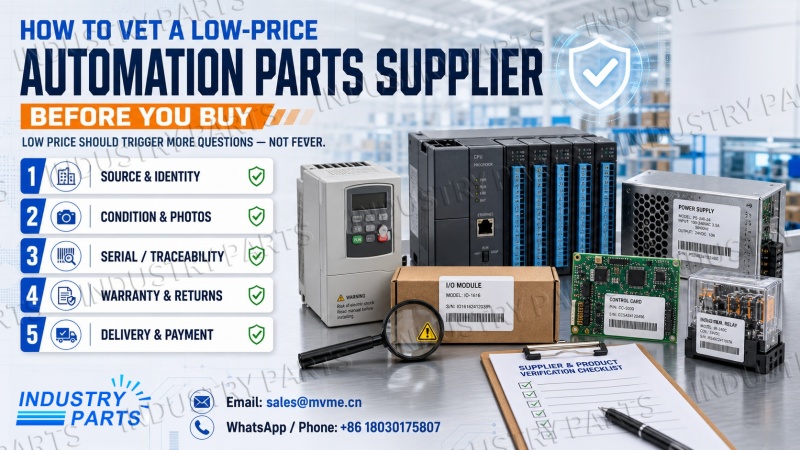
How to Vet a Low-Price Automation Parts Supplier Before You Buy
A low quote is not proof of a bad part. It is proof that something in the offer is different. The buyer’s job is to find that difference before the purchase order is released.
Three suppliers can quote the same catalog number and still be selling three different things. One may have factory-new stock through an authorized channel. Another may hold unused surplus from a cancelled project. The third may be offering a repaired unit in replacement packaging. If every line says “new and original,” the price comparison is almost meaningless.
The lowest price can be the right choice. It can also be the most expensive route to a line restart. The difference is not the discount itself; it is how clearly the supplier can explain the product’s identity, condition, source, availability and remedy if the item is wrong.
Start with the gap, not the suspicion
A large price difference deserves a question, not an accusation. Automation parts move through several markets, and the reasons for a lower quote are not all negative.
Reasons a lower price may be reasonable
- The supplier owns old inventory and wants to reduce stock.
- The item is unused surplus rather than current factory stock.
- The warranty is supplied by the seller, not the manufacturer.
- Packaging is damaged or has been opened for inspection.
- The quote excludes freight, duty, tax or accessories included elsewhere.
- The seller accepts a smaller margin to complete a transaction quickly.
Reasons the same gap may signal risk
- The supplier does not own the stock and is quoting an unconfirmed broker chain.
- The condition has been described more generously than the evidence supports.
- The hardware series, firmware or manufacturing revision is different.
- Important accessories, licenses or connectors are missing.
- The product has been repaired, modified or relabeled.
- The quote is designed to win the order before the seller starts searching.
Define the condition in plain language
Words such as “new,” “original,” “surplus” and “refurbished” are used differently across the market. Put the definition in the quotation and the purchase order. The description should tell the buyer what has happened to the unit, not merely what the seller prefers to call it.
| Quoted condition | What the buyer should establish | Useful evidence before shipment |
|---|---|---|
| Factory-new through an authorized source | Current product, supplied through a manufacturer-recognized route, with the applicable manufacturer support and warranty terms. | Official partner verification, manufacturer or authorized-distributor documentation, current labels and serial details where available. |
| Unused surplus / new old stock | Not previously placed into service, but possibly older, outside the current authorized route, or no longer covered by the manufacturer. | Actual photos, seal and packaging condition, date or lot markings, serial details, source explanation and seller warranty. |
| Refurbished or repaired | Previously used or defective, then serviced. The work performed and the party responsible should be disclosed. | Repair scope, changed components if known, test report, test equipment or procedure, technician or facility identity and warranty terms. |
| Used / system pull | Previously operated. Working status, removal reason and current test status should be stated separately. | Photos of the actual unit, cosmetic condition, serial and revision, powered test results if available, return period and exclusions. |
Rockwell Automation’s official gray-market guidance gives a useful reason for this precision: it describes cases where old, used, modified or repaired products were repackaged and represented as new. Siemens also warns buyers that products outside its authorized network may be used, out of date, damaged or counterfeit, and may not carry the expected official support or warranty.
Verify the supplier before debating the product
Good product photos cannot repair a weak commercial counterparty. Confirm who will receive the money, who will issue the invoice and who will be responsible if the item fails inspection.
Match the business identity
The legal company name, invoice name, bank beneficiary and contract party should make sense together. Differences are not automatically fraudulent — trading groups often use related companies — but the relationship should be explained in writing before payment. A last-minute bank change deserves a fresh confirmation through a known contact channel.
Audit authorization claims independently
If a seller says it is “authorized,” do not accept a logo in an email signature as proof. Siemens, Rockwell Automation and Schneider Electric provide official partner or distributor resources. Search the legal company name, check the relevant country and product line, or contact the manufacturer’s local office.
Check certificates, but read the scope
An ISO 9001 certificate can support a supplier’s quality-management claim. It does not authenticate a PLC on its own. ISO directs users to IAF CertSearch or the relevant certification and accreditation bodies to verify accredited certification. Check the company name, site, status, validity and scope rather than accepting a PDF at face value.
Ask for evidence that exists today
A stock photograph proves that the model exists. It does not prove that the supplier has it. For a meaningful order, ask for evidence tied to the current quotation.
- Can you provide photos of the actual item beside a note showing our RFQ number and today’s date?
- What is the complete catalog number, including suffix, series, hardware revision and firmware where applicable?
- Is the item physically in your warehouse, held by an identified partner, or still being sourced?
- How do you define the quoted condition, and has the unit ever been installed, powered, repaired or opened?
- What packaging, connectors, terminal blocks, keys, memory cards, licenses or accessories are included?
- Can you provide serial, date-code and label photos? If full serial disclosure is restricted, what can be shown before payment?
- What inspection or functional test has been performed, by whom and against what acceptance criteria?
- May the buyer or an agreed third party inspect the item before shipment?
- What does the warranty cover, when does it begin, and who pays freight if the item is incorrect or defective?
- What is the real ship date, ship-from location, Incoterm and proposed carrier?
Not every purchase needs every document. A low-risk cable and a safety controller should not pass through the same review. Scale the evidence to the part’s criticality, the order value, the difficulty of commissioning and the cost of another shutdown.
Current products and obsolete parts need different routes
For a current product, the manufacturer’s authorized network is the cleanest benchmark for availability, warranty and support. Official partner locators make an authorization claim easy to check. Rockwell Automation states that its warranty and certain firmware or software rights depend on purchase through an authorized source. That can materially change the value of a lower quote.
Legacy and discontinued parts are different. Authorized stock may have ended years earlier, while the installed system still has to run. An independent trader, repair provider or surplus channel may be the only practical supply route. In that market, the honest supplier does not borrow the language of an authorized distributor. It states the actual condition, the source type, the inspection performed and the warranty it can support itself.
For a current part
Compare the low quote with an official-channel offer. Check manufacturer warranty, software rights, registration, latest revision and standard lead time. Ask why the alternative quote is lower.
For a discontinued part
Check the official lifecycle status and successor first. Then focus on actual-stock evidence, condition history, version compatibility, test scope, storage, return rights and a migration backup plan.
Check the part, not only the paperwork
Documents can be copied. A label can be photographed. The evidence pack should agree across several points: model, serial, hardware revision, date code, packaging, country marking, physical construction and the data held by the manufacturer or certification body.
- Compare the full order number with the manufacturer’s current or archived product page.
- Check whether the revision and firmware fit the installed project and engineering software.
- Review label placement, print quality and security features against official manufacturer guidance where available.
- Use manufacturer registration or authentication tools for supported products.
- Verify safety certifications through the issuing body’s database when certification is part of the requirement.
UL Solutions describes Product iQ as its official source for UL certification information and allows searches using items such as a file number, model number or category code. UL also notes that certification alone does not establish whether a component is suitable for a particular end use; ratings and conditions of acceptability still matter.
Compare usable cost, not the first number
Put every quote on the same basis. Include the condition, evidence, warranty, accessories, inspection, freight, duty, tax, payment risk and likely commissioning work. A part that arrives quickly but cannot be loaded into the installed project is not the cheaper part.
Good suppliers sometimes give short answers because the answer is simple. Weak suppliers often give long answers that avoid the question. Look for consistency more than polish.
Frequently asked questions
Does a very low price mean the part is counterfeit?
No. It means the offer needs an explanation. Owned surplus, old stock, different warranty coverage or an excluded accessory can produce a legitimate discount. Counterfeit, repaired or brokered stock can also produce one. Evidence separates them.
Is an ISO 9001 certificate enough to approve a supplier?
No. Verify the certificate and its scope, but treat it as one part of due diligence. It does not prove the authenticity, condition or compatibility of the specific automation component.
How can a buyer verify that a supplier is authorized?
Use the manufacturer’s official partner or distributor locator and search the supplier’s legal name, country and relevant product line. If the result is unclear, ask the manufacturer’s local office rather than the seller.
What if the supplier will not show the full serial number?
There can be legitimate concerns about serial-number misuse. Ask for a partially redacted image that still shows label layout, revision, date information and enough digits to link later inspection to the offered item. Agree when the complete serial will be disclosed.
Should buyers avoid all independent traders?
No. Independent sourcing is often relevant when the manufacturer has discontinued a part or the normal lead time does not fit the recovery window. The supplier should describe the channel honestly and provide evidence appropriate to the added risk.
Who should approve a proposed replacement model?
The machine owner, system integrator or qualified engineer should approve technical compatibility. A supplier can provide official successor information and documents, but it should not turn a catalog cross-reference into an engineering guarantee.
Need to check an automation-parts offer?
Send the manufacturer, full model number, quantity, quoted condition and required date. IndustryParts can help organize the commercial and lifecycle information available for the request. Technical acceptance should remain with your engineering team.