

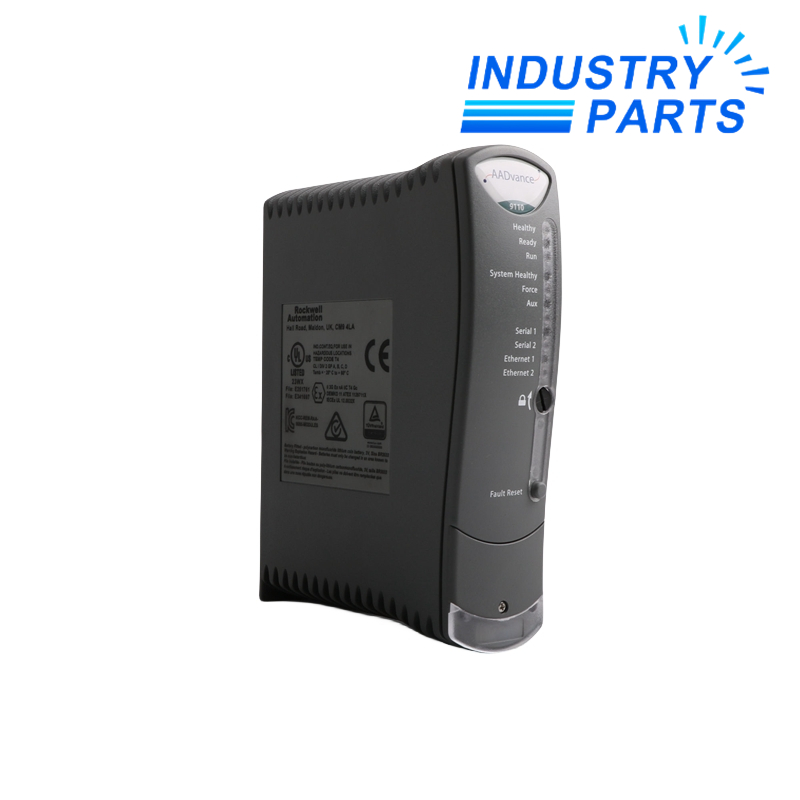


Allen-Bradley T9110 AADvance Processor Module
The 400 MHz main processor for modular AADvance safety controllers in simplex, dual and triplicated architectures.
Key Information
T9110 is the processor module for the Allen-Bradley AADvance process safety controller. It installs on a T9100 processor base and supports 1oo1D, 1oo2D and 2oo3D processor architectures.
Rockwell Automation identifies T9110 as an active, repairable/replaceable product. Certified safety configurations use at least two processors for safety-critical applications, with dual or triplicated arrangements supporting SIL 3 under the safety manual conditions.
Functions
- Executes the AADvance safety application and coordinates the modular I/O subsystem.
- Supports dual and triplicated processor arrangements for fault tolerance and safety integrity.
- Maintains system time, sequence-of-events processing and controller diagnostics.
- Provides two serial communication ports per installed processor module.
- Supports firmware management through the applicable ControlFLASH workflow and recovery image.
Specifications
| Manufacturer | Rockwell Automation / Allen-Bradley |
|---|---|
| Model | T9110 |
| Product Family | AADvance Process Safety System |
| Product Type | Processor module |
| Processor Clock | 400 MHz |
| Boot Flash | 512 kB |
| SRAM | 512 kB |
| Bulk Flash | 64 MB |
| SDRAM | 32 MB |
| Sequence-of-Events Resolution | 1 ms for internal variables |
| Self-Test Interval | Less than 5.5 hours |
| Architectures | 1oo1D, 1oo2D and 2oo3D |
| Safety Configuration | Two processors for safety use; dual or triplicated configurations can support SIL 3 under the safety manual |
| Module Power Consumption | 8.0 W worst-case design value |
| Processor Base | T9100 with compatible hardware revision |
| Current Firmware Family | Normal mode 2.011 and recovery mode 1.020 for the current published release |
| Firmware 2.011 Security | SSH replaces Telnet and signed firmware images are verified |
| Lifecycle Status | Active |
| Unique Product Identifier | T9110 |
Installation
- Export and independently verify the AADvance project, application checksum, firmware matrix, diagnostics and network settings.
- Record every T9110 hardware revision and its slot on the T9100 processor base.
- Confirm the certified hardware/software combination and maintenance time assumptions before removing a processor from a redundant group.
- Use the documented first-slot E1-1 connection for the applicable ControlFLASH Plus procedure.
- After insertion, confirm synchronization, healthy redundancy, application equivalence and all required safety validation tests.
Lifecycle
- Track processor degradation and replace a failed module within the mean-time-to-repair used in the PFD calculation.
- Keep hardware revision, normal firmware, recovery firmware and Workbench version in one controlled configuration record.
- Preserve project backups and firmware packages under cybersecurity and functional-safety change control.
- Review product notices and label date codes before accepting repaired or surplus hardware.
FAQ
How many T9110 processors are needed for a SIL 3 AADvance application?
The certified architecture uses two or three T9110 modules under the safety-manual conditions; one processor is not the SIL 3 configuration.
What must match before a spare T9110 joins a running redundant controller?
Check hardware revision, normal and recovery firmware, T9100 base revision, Workbench release, application checksum and the site synchronization procedure.
What is the safest T9110 firmware-upgrade preparation?
Create a verified project backup, record every module revision and firmware build, confirm the compatibility matrix and recovery path, then follow the approved safety-system change procedure.
How should a degraded T9110 processor group be managed?
Use the safety requirement specification and PFD assumptions to determine the allowed repair time, compensating measures and whether the affected functions must be shut down.
Which commissioning evidence should follow a T9110 replacement?
Retain module identity, firmware, synchronization status, application checksum, diagnostics, bypass history, proof-test results and final redundancy state.


