

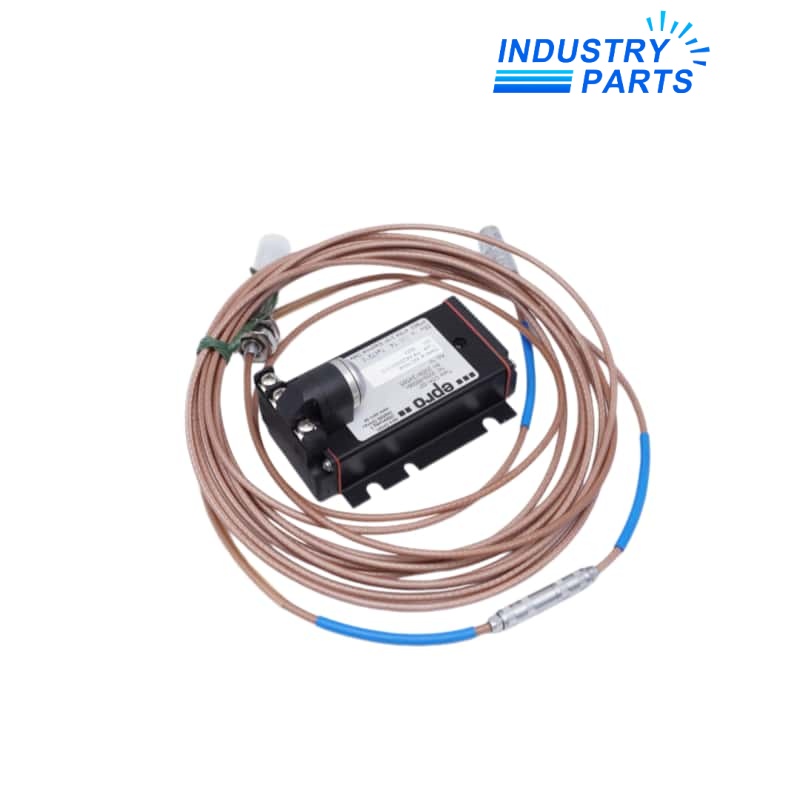


Emerson EPRO CON021 Eddy-Current Signal Converter
A panel-mount converter for standard-range PR6422, PR6423, PR6424 and PR6426 eddy-current sensor systems.
Key Information
CON021 is an Emerson EPRO eddy-current signal converter for critical rotating machinery such as steam, gas and hydro turbines, compressors, pumps and fans. It converts compatible probe signals for radial or axial shaft displacement, position, eccentricity and speed/key measurement.
The base CON021 supports standard-range PR6422, PR6423, PR6424 and PR6426 sensors. Extended-range applications use separately coded CON021/91x-xxx variants, so the base model must not be substituted where an extended calibration is required.
Functions
- Excites and conditions the matched eddy-current probe signal.
- Provides a 0 to 20 kHz frequency response for static and dynamic shaft measurements.
- Interfaces compatible probes through a self-locking Lemo connection.
- Provides screw-terminal supply and output connections for panel wiring.
- Supports standard measuring ranges from 1.0 to 8.0 mm according to the selected probe family.
Specifications
| Manufacturer | Emerson / EPRO |
|---|---|
| Model | CON021 |
| Product Type | Eddy-current signal converter |
| Compatible Standard-Range Sensors | PR6422, PR6423, PR6424 and PR6426 |
| Standard Measuring Ranges | 1.0 mm, 2.0 mm, 4.0 mm and 8.0 mm by sensor family |
| Frequency Range | 0 to 20,000 Hz at -3 dB |
| Rise Time | Less than 15 µs |
| Supply Voltage | -23 to -32 V for -4 to -20 V output; -21 to -32 V for -2 to -18 V output |
| Operating Temperature | -30 to 100 °C |
| Shock / Vibration | 5 g at 60 Hz at 25 °C |
| Protection Class | IP20 |
| Housing Material | LMgSi 0.5 F22 |
| Probe Connection | Self-locking Lemo plug |
| Supply / Output Connection | Screw terminals, maximum 1.5 mm² conductor |
| Mounting | Four M5 × 20 screws supplied |
| Compliance | CE, ATEX, IECEx, CSA and UL markings under the documented conditions |
| Variant Boundary | Extended-range service requires the matching CON021/91x-xxx catalog variant |
Installation
- Confirm the probe family, measuring range, total cable configuration and exact converter label before replacement.
- Record supply polarity, output wiring, grounding and mounting position.
- Use the required barrier or current limitation where the hazardous-area approval calls for it.
- Seat the Lemo connector without cable strain and keep sensor wiring separated from high-energy conductors.
- Verify static calibration, dynamic response, gap voltage, alarm polarity and the monitor input before release.
Lifecycle
- Keep CON021 calibration and probe/cable identities together as one asset.
- Inspect screw terminals, Lemo latch, grounding and enclosure contamination during shutdown maintenance.
- Trend zero, sensitivity and gap voltage to identify sensor-system drift.
- Do not replace an extended-range CON021/91x-xxx with the base CON021 without re-engineering and recalibration.
FAQ
How do I know whether base CON021 or an extended-range variant is required?
Check the installed converter label, probe model, required measuring range and calibration record. Extended ranges use a specific CON021/91x-xxx identity.
Can CON021 be calibrated without the installed probe and cable?
A reliable system calibration must use the matched probe, cable length, converter and representative target material because each element affects the transfer characteristic.
What hazardous-area information should accompany a CON021 enquiry?
Provide the area classification, existing approval marking, ambient range, barrier or current-limiting arrangement and the complete probe/converter loop drawing.
What should be checked if a CON021 output is saturated?
Check mechanical gap, probe/cable continuity, connector seating, supply voltage and polarity, correct converter range, target material and monitor input loading.
Which records should close a CON021 replacement?
Retain the converter and probe labels, cable configuration, calibration curve, supply/output readings, gap voltage, alarm/trip results and hazardous-area verification.


