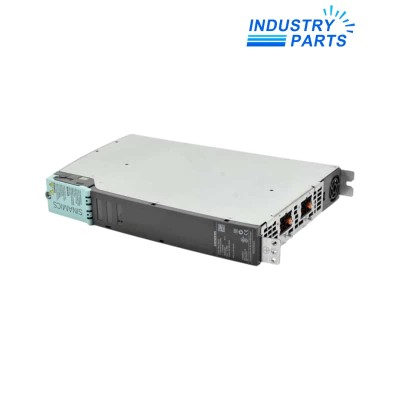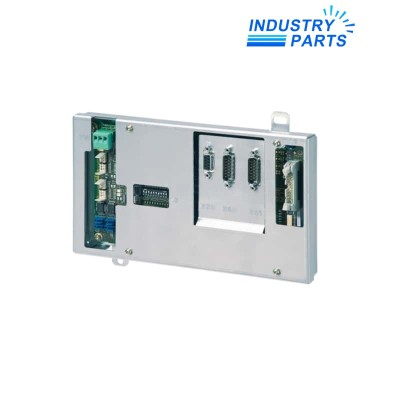

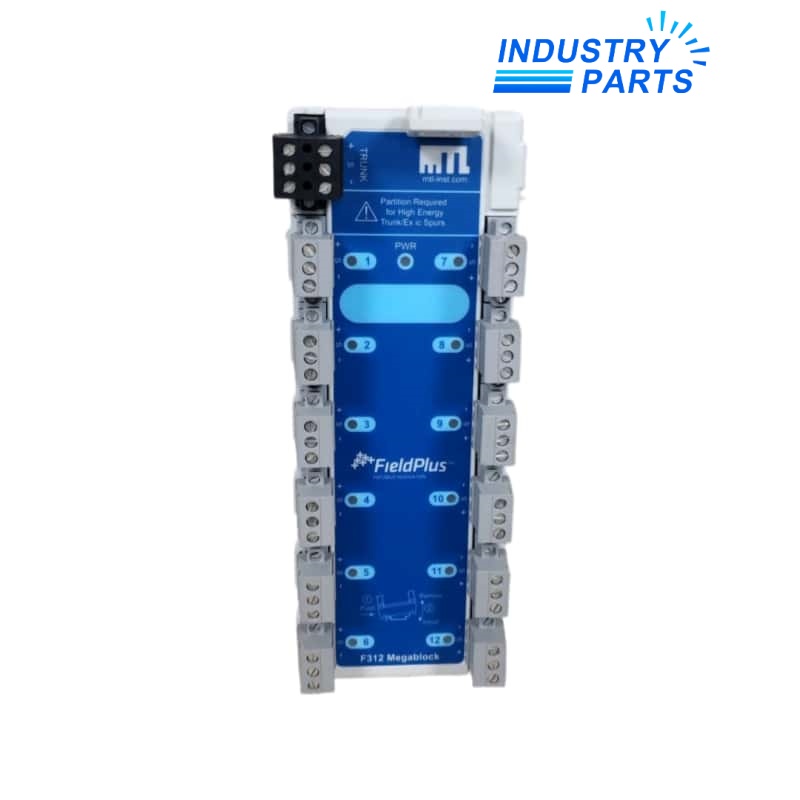
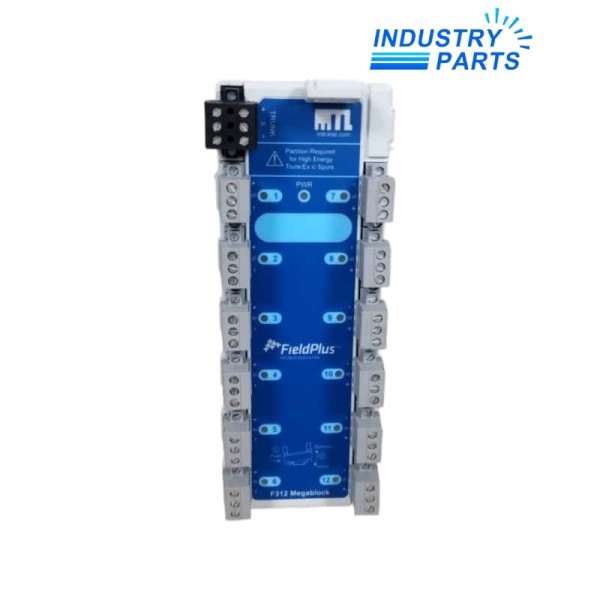
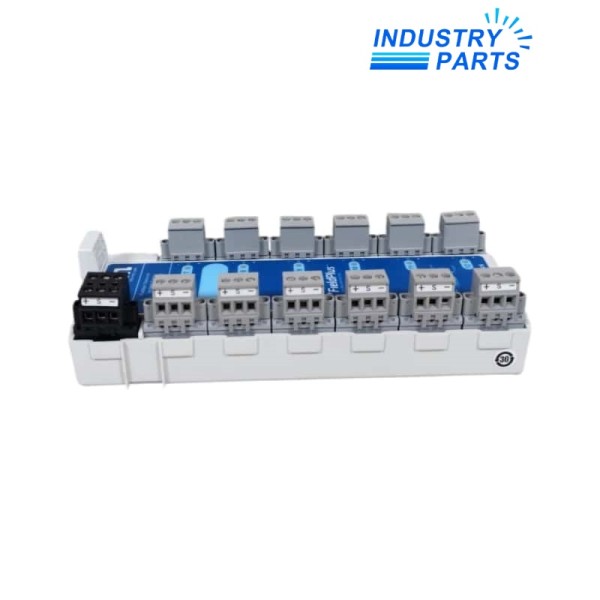
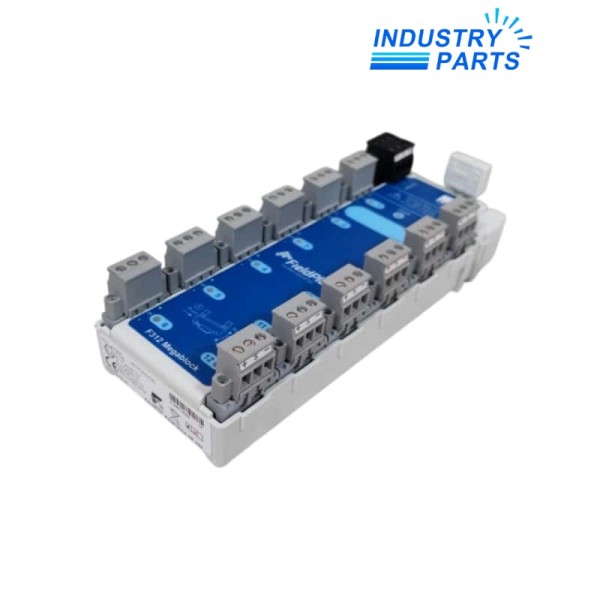
Eaton MTL F312 12-Way Fieldbus Megablock
A DIN-rail fieldbus device coupler with twelve screw-terminal spurs, short-circuit protection and an included F97 terminator.
Key Information
F312 is the 12-way screw-terminal member of the Eaton Crouse-Hinds MTL F300 Megablock range. It connects field devices to a Foundation Fieldbus H1 or PROFIBUS PA segment trunk while providing individual spur connections and short-circuit protection.
The F312 includes an F97 terminator. Pluggable trunk and spur connectors simplify commissioning, and optional FS32 surge-protection modules can be fitted with the corresponding grounding bars.
Functions
- Connects as many as twelve field devices to one fieldbus segment trunk.
- Limits the effect of a spur short circuit so the rest of the segment can continue communicating.
- Provides pluggable screw-terminal connectors for trunk and spur wiring.
- Accepts the included F97 segment terminator in the trunk terminals.
- Supports optional FS32 protection on trunk or spur positions with the appropriate grounding hardware.
Specifications
| Manufacturer | Eaton Crouse-Hinds series / MTL |
|---|---|
| Model | F312 |
| Product Family | F300 Megablock |
| Product Type | 12-way fieldbus device coupler |
| Spur Count | 12 |
| Terminal Style | Pluggable screw terminals |
| Included Accessory | F97 fieldbus terminator |
| Physical Networks | IEC 61158-2 Foundation Fieldbus H1 and PROFIBUS PA |
| Spur Device Current | 38 mA maximum; one device per spur recommended |
| Spur Short-Circuit Current | 56 mA maximum |
| Trunk-to-Spur Voltage Drop | 1.25 V maximum |
| Module Current Consumption | 6.5 mA |
| Mounting | DIN rail |
| Dimensions | Approximately 188.4 mm × 69.1 mm × 50.5 mm |
| Field Certification Compatibility | Uncertified, Ex d, Ex e, Ex nA and Ex ic under the documented installation conditions |
| Hazardous-Area Approvals | ATEX and IECEx; verify product marking and installation drawing |
| Optional Surge Protection | FS32 modules with F300/F312 grounding bars |
| Spring-Clamp Variant | F312-PC is a separate catalog item |
Installation
- Calculate the segment voltage and current budget with the 1.25 V maximum trunk-to-spur drop included.
- Ground the segment shield at one designated point to avoid a ground loop.
- Fit and secure each pluggable connector, observing signal polarity and shield termination.
- Use the required trunk-spur partition when high-energy trunk or Ex ic spur rules call for it.
- After energizing, check the PWR indication and verify communications with every connected field device.
Lifecycle
- Keep the F97 terminator position documented so the segment never operates with a missing or extra terminator.
- Inspect plug retention, terminal tightness, shield continuity and any fitted FS32 protector during shutdown maintenance.
- Record which spur numbers are occupied and preserve the junction-box cable schedule.
- Treat F312-PC, F312-V2 and other variants as different orderable identities that require connector and certification review.
FAQ
What segment calculations should be completed before adding devices to F312?
Recalculate trunk voltage, each spur load, cable resistance, the 1.25 V maximum coupler drop and the power-conditioner capacity for the full operating range.
Can F312 be exchanged with F312-PC without rewiring?
No assumption should be made: F312 uses screw-terminal connectors while F312-PC uses spring-clamp terminals, so connector style, enclosure and approval details must be checked.
When does F312 need the trunk-spur partition?
Use the partition where the installation drawing requires separation for a high-energy trunk and Ex ic spurs; confirm the hazardous-area design before live work.
How should F312 surge protection be specified?
State which trunk and spur positions need FS32 modules and include the correct F300/F312 grounding bars and a low-impedance earth connection.
What should be recorded before replacing F312 in a field junction box?
Capture every trunk and spur conductor, polarity, shield, device tag, terminator position, surge protector and hazardous-area label before disconnection.